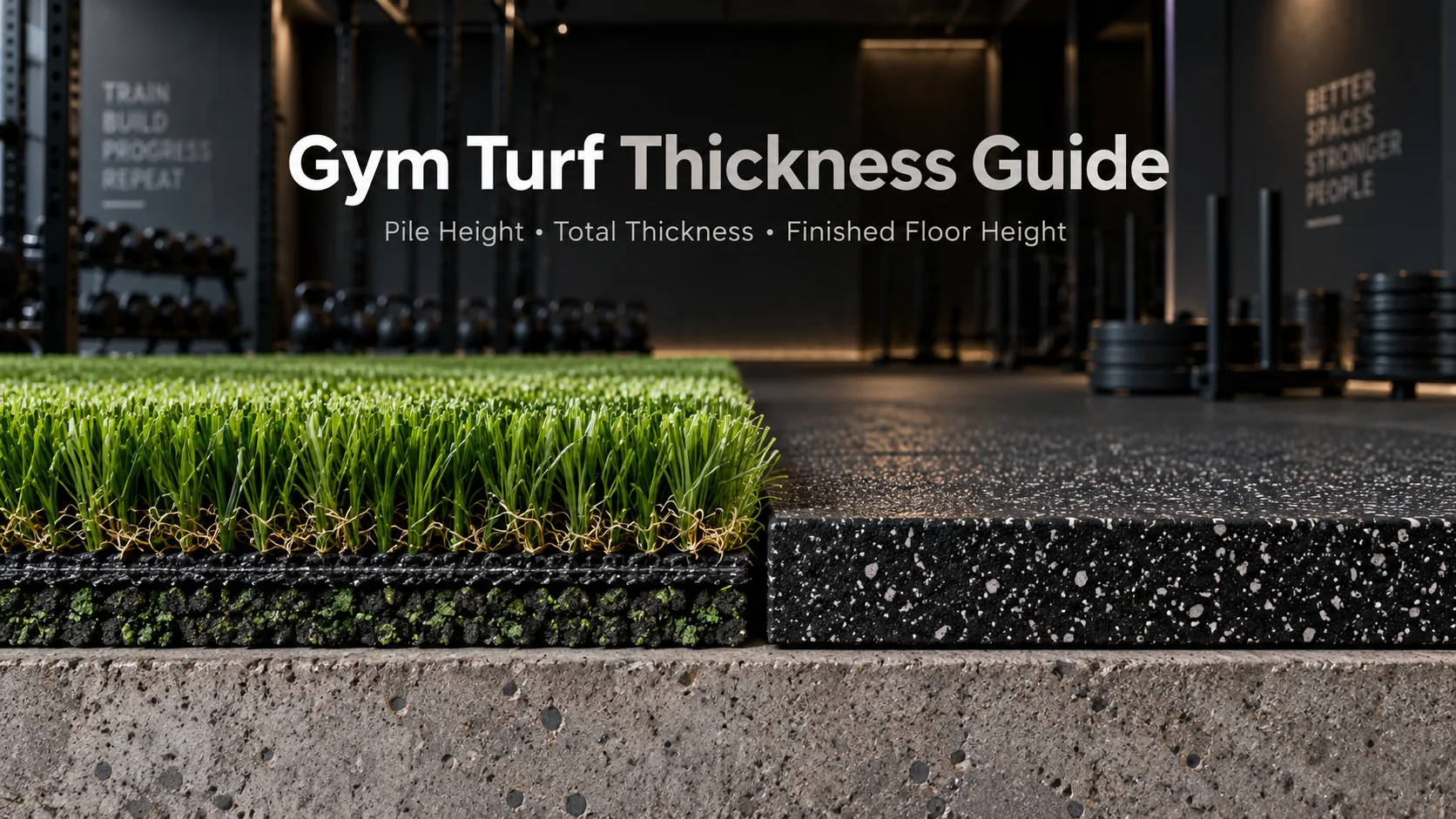
Gym Turf Thickness Terms: Pile Height, Overall Thickness, and Finished Floor Height
Gym turf thickness is not one measurement. A quote may describe the blades, the whole delivered product, or the final surface after installation — and gym turf pile height, gym turf overall thickness, and gym turf finished floor height each answer a different question. Because published figures for artificial turf can treat padding and backing as inside or outside the number, the layer list behind a specification matters as much as the figure itself. A height comparison is only valid when both sides are measured from the same base and describe the same finished surface.
Why two 15 mm quotes may not use the same measurement basis
A single reference product line illustrates the gap: shorter pile can measure as thin as 1/4 inch when no attached backing pad is included, while taller versions may measure 3 inches or more once padding or backing is counted. The same nominal figure can therefore be a blade-only measurement in one quote and a product-inclusive measurement in another. This is also why 10 mm vs 15 mm gym turf, or a 20 mm gym turf thickness option, cannot be ranked on the number alone. A matching guide for this category lists 10 mm as standard, 15 mm as a balanced choice, and 20 mm as maximum cushioning, with PU foam, TPE, or rubber used as a level-adjustment underlay layer, and it advises measuring existing flooring first. Those figures describe the turf assembly; they do not by themselves confirm durability, sled suitability, or shock absorption.
Backing and attached padding: what is already inside the quoted number
Gym turf backing thickness and gym turf attached padding are frequently bundled into an overall figure and just as frequently excluded from it. If the stated product thickness already includes a factory-attached pad, do not add that same pad again. A separate on-site underlay is a different layer and should be counted once if it is actually part of the installation. When a number is unclear, treat it as unverified and confirm which layers it covers rather than assuming the more favorable reading.
What Gym Turf Thickness Can and Cannot Tell You
For commercial gym turf, a thickness figure describes geometry, not performance. It helps confirm how much vertical space a product occupies and whether two products are being measured the same way. It does not certify how long a surface will last, how well it absorbs impact, or whether it is appropriate for a specific activity.
Thickness is not a durability rating
Durability is usually carried by other specifications. Published indoor turf ranges illustrate this: in the OnDeck Sports gym turf line, tiers are distinguished by face weight — from a 48 oz poly product up to a 58 oz nylon product — while all of them share a 5 mm foam pad and require no infill. That same pad dimension across tiers described at different performance levels suggests durability is being expressed through a different specification. So before treating a number as a quality signal, check whether the quote refers to blade height, the delivered product, or the installed surface, and confirm which layers are included.
Sled suitability and shock absorption require evidence beyond one number
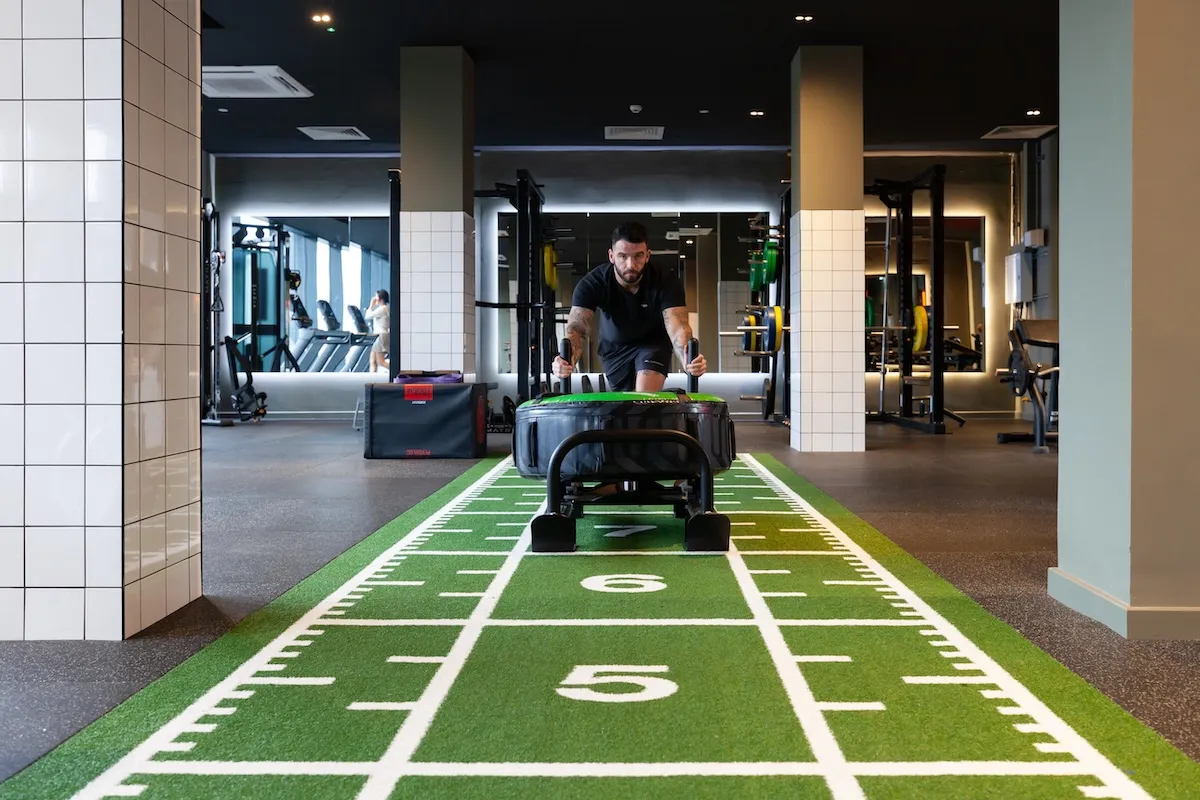
For an indoor sled track, a turf thickness figure alone cannot show whether a surface suits sled work, and it says nothing reliable about shock absorption. Those outcomes depend on the full build — backing, any factory-attached pad, separate underlay, the base, and the fixing method — plus how the surface is actually used. Two products can share a stated figure and behave differently. If the question is what thickness of turf do you need for a gym, or how thick artificial turf for a gym should be, the layer list and the conditions behind any performance claim matter more than the headline dimension. Matching an adjacent floor system raises the same point: the best turf thickness for gym flooring is the one whose confirmed finished height and build suit the zone — a project decision, not a universal number.
Matching Gym Turf and Adjacent Rubber Flooring from the Same Subfloor
Two surfaces sharing one subfloor should also share one measuring datum: the plane both rest on. Measure the turf side as a full build-up and the adjacent rubber floor as a completed system, then compare. Neither the gym turf finished floor height nor the gym turf adjacent rubber flooring height means anything until both are referenced to that same plane, and a quoted gym artificial grass thickness cannot stand in for either.
Same-reference-subfloor comparison method step by step
- Fix the reference. Treat the top of the common subfloor as zero for both sides and measure upward only.
- Confirm what the turf figure contains. Establish whether the quote covers blades alone, the delivered roll, or the installed build-up, then use the total thickness as delivered.
- Add only what is missing. Count a separate underlay once — and not at all if it is already inside the factory figure.
- Read the adjacent floor as a system. Use its completed height, not a sum of parts inferred separately.
- Subtract, never add. Turf-side height minus adjacent-side height gives the offset you need to transition.
Hypothetical example: 15 mm turf plus 5 mm separate layer vs. 20 mm adjacent floor
This is a calculation example, not a measured installation and not an endorsement of any particular underlay.
Conditions: one shared, level subfloor; turf total thickness 15 mm with factory padding included; a 5 mm separate layer added on site; adjacent floor finished height 20 mm; no other layers.
| Item | Value |
|---|---|
| Turf total thickness (pad included) | 15 mm |
| Separate on-site layer | 5 mm |
| Turf side finished height | 20 mm |
| Adjacent floor finished height | 20 mm |
| Offset | 0 mm |
The arithmetic is 15 + 5 = 20 mm against 20 mm, so the two sides match. A nominal pile figure cannot replace that confirmed total, because pile height alone does not describe the pad the turf already carries. Matching heights also say nothing yet about material compatibility, fixing, or load behavior — those are separate checks.
Attached Padding vs. Separate Underlay: Avoiding Double-Counting in Gym Turf Thickness
Padding reaches the floor in one of two places: inside the product as delivered, or added on site. A turf factory's stated gym turf thickness may or may not already contain the pad, and that single unknown is where most height errors start.
When factory-attached padding is already inside the overall thickness
If the overall figure already contains the attached pad, add only the remaining site layers. List each layer and mark it included or excluded: pile, gym turf backing thickness, attached pad, then any separate underlay and adhesive. A commercial gym turf thickness figure that bundles pile, backing, and pad cannot have a pad thickness added a second time; doing so inflates the finished height by roughly that pad's thickness and can overshoot a threshold or adjacent floor. Pile height cannot stand in for the overall figure, because it describes the blades and says nothing about what sits beneath them. If a quote does not say whether the pad is inside the number, that is a question for the supplier.
What height matching does not confirm: compatibility, fixation, and compression
Two assemblies that measure the same are not automatically equivalent in service. A factory-attached pad arrives as part of the roll; a gym turf separate underlay is an independent layer with its own interface to the subfloor and to the turf above. Fixation method, edge treatment, and whether the underlay is bonded or loose all change how the stack behaves. Layers also compress under load by different amounts and at different rates, so a stack that is flush at handover may not stay flush where traffic concentrates. Matching says nothing about whether the pad and turf were designed to work together, or whether the combined assembly suits the intended training use. Treat the comparison as a dimensional check and confirm pairing, fixing, and expected compression separately.
Gym Turf Thickness Specification Checklist Before Comparing Products
A gym turf specification checklist turns a stack of quotes into comparable data. Record the same fields, in the same units, for every product before you rank them. Without that discipline, comparing a pile height from one supplier against a total figure from another produces a false conclusion.
Dimensions, inclusions, and measurement conditions to record
- Pile height of the yarn.
- Overall thickness as delivered, and the layers it contains.
- Backing information if stated, and whether it contributes to the overall figure.
- Attached padding: present or not, and its thickness range.
- Separate underlay: thickness, and whether it is already counted in the number above.
- Roll width and roll length, since these affect layout and seam positions.
- Whether the figure is nominal or measured, and the unit it is quoted in.
Missing details that require supplier or project confirmation
If a data sheet gives only one thickness number, confirm which layer list sits behind it. Ask whether attached padding falls inside or outside that number, and whether attaching it limits the available roll width. Check that the stated roll width and length are actually available for your layout rather than only listed as options. Confirm the subfloor condition and the completed height of any adjacent floor, because a flat comparison depends on both sides sharing one reference plane. Also confirm that the figures refer to the same measurement condition.
A checklist cannot answer how thick should gym turf be for a given activity; it shows whether two products are described in the same way. Compare like with like, then view Gym Turf options when you are ready to match a configuration to your floor build-up.